In a long winter power cut it is older people in cold houses who get hurt: by the cold itself, or by the camping stove carried indoors to beat it. This is how a grid engineer of forty-two years keeps a British home warm, fed and safe for a week without power, on a pension budget.
Sort My House Before the Lights Go£27 · one payment · instant download
Sort it now, in daylight, in an afternoon. Leave it, and you will be sorting it in the dark, in the cold, with a phone on ten percent.
Nothing is posted, and there is no account to make.
My name is Keith Brindley. I started as an apprentice electrical fitter in 1977 and retired in 2019. In between I was a substation fitter, a cable jointer, a protection engineer, and for my last twelve years a senior control engineer on the regional control desk, running the switching and the restoration when the weather turned.
On a bad night on the desk the alarm list scrolls faster than you can read it. Breakers trip and lock out, trees are across the roads, and every crew can only be in one place. Most homes come back within hours. The last few streets, at the far end of a long line, can wait days.
Those last few streets are who I wrote this for. A modern house leans on electricity far more than the houses of the 1970s cuts did. The boiler, the phone, the hob, the shower and the freezer all stop together, in an order you can predict, and every one of them has a simple answer if you sort it out before the night it happens.
It has all happened in living memory:
None of those was the end of the world. Every one went on longer than people expected on the first evening, and every one was far easier for the houses that had light, heat, water and food sorted before the lights went.
What a long winter power cut costs a house with no plan, set against what is in the book.
One freezer saved in one power cut pays for the book.
Real pages from the real book. This is exactly what opens on your phone.
← swipe to see more pages →
When a fault hits an overhead line, the breaker at the substation trips, waits a moment and closes again on its own. If the fault has blown clear, you are back on before the kettle notices. If it hasn't, the breaker tries a set number of times and then locks out, and from then on a person has to deal with it.
So my rule at home is simple. Five minutes, then torch on and pencil out. Ring 105, the free number for power cuts, and write down the time and what they tell you. Fill a flask while the kettle is still warm, and keep the fridge and freezer doors shut.
And never bring a camping stove, a barbecue or a patio heater indoors to warm up. That is the one rule in the book I will not bend.
That is one page. The book has 100, and the card for your kitchen wall.
Combi boilers, storage heaters, the fuse board and the loft tank. Litres, degrees Celsius and pounds. Every chapter ends with a short checklist.
Instant download, on your phone about a minute after you pay. Nothing is posted.
Keith Brindley · 100-page book · reads on any phone, tablet or computer
I'm Keith Brindley. I grew up in a Lancashire mill town and did my homework by candlelight in the 1972 and 1974 power cuts. I joined as an apprentice at eighteen, spent the 1980s jointing cables in all weathers, and finished my working life running switching and restoration on the regional control desk. I retired in 2019.
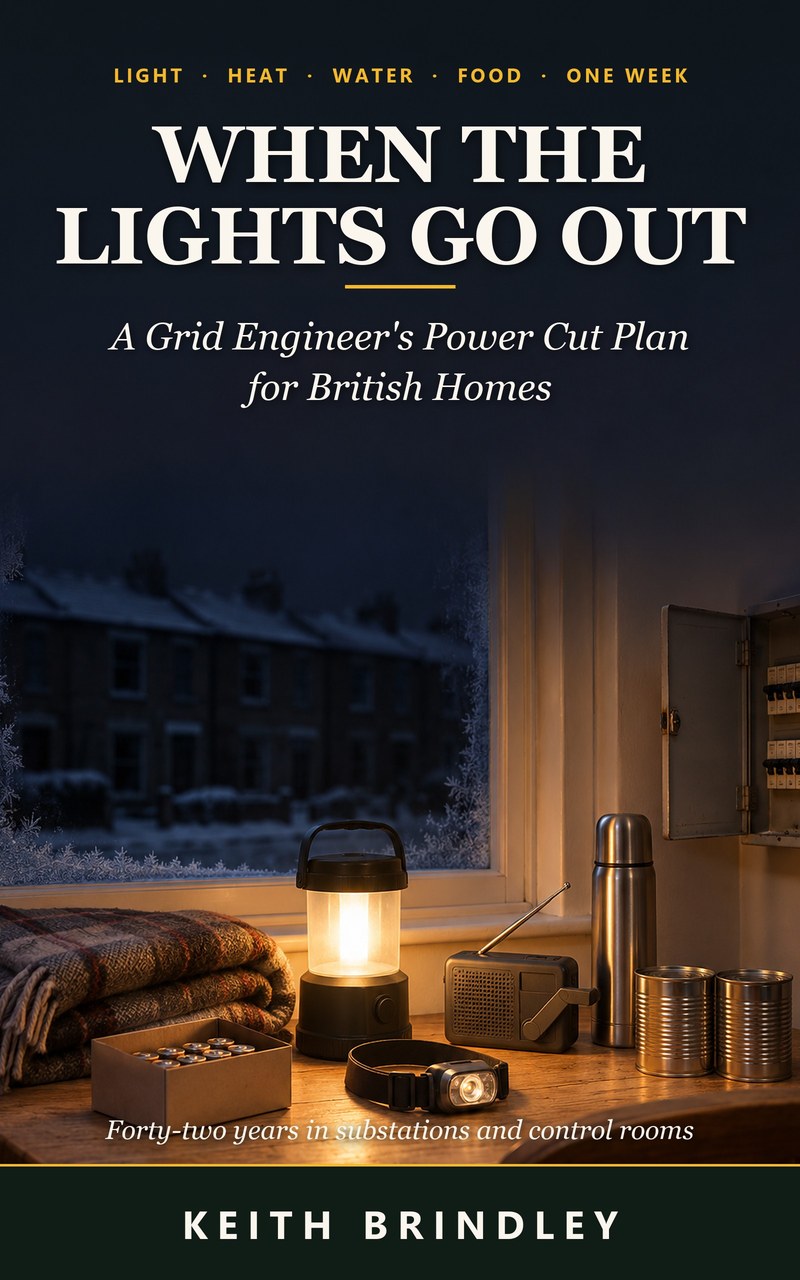
Jean and I live in a 1930s semi with a gas combi boiler, the same as millions of you. I turned the garage into a workshop, and one shelf of it is the power cut shelf: torches, batteries, a wind-up radio, a camping stove for outside, water, and a list on the wall.
When the lights go out at ours, I check the neighbours' windows, ring 105, light the lantern and fill the flasks. This book is how you get there too.
Neither do I. No bunker and no generator in the lounge. It is a shelf in the cupboard and a plan on the wall, the way you keep a spare tyre in the car.
A week for one person fits on the floor of a wardrobe. The book covers flats, including door entry systems, lifts and water pumped to the upper floors.
You don't buy it in one go. The week plan adds a few things to a normal shop, cheapest first, and most of the store list is food you already eat.
Then this book is for you. Chapter 5 is the warm room without any heating at all, and chapter 7 is food that is fine cold or needs only a flask of hot water.
No. Combi boilers, storage heaters, the fuse board and the loft tank. 105 for power cuts, the Priority Services Register, litres, degrees Celsius and pounds. Written by a man who worked on the British network for forty-two years.
Yes. It is a 100-page book, an instant download. Print the kitchen-wall card and the checklists, or the whole thing. On a phone or tablet you can make the words as large as you like.
Press any Buy button on this page. Pay once on the secure checkout. The page that opens right after you pay has your download button, and the same link is sent to your email. No account to set up, no password to remember.
You don't need to be. Three taps: Buy, pay with your card, then Download. The book opens on the screen the way a photo does. Spread two fingers on the page to make the words bigger.
No. One payment of £27, one time. No membership and no monthly anything.
Then you get your money back. Ask within 30 days and it is refunded in full.
One warm room. Light and the radio on. A week of food and water in. One card on the kitchen wall.
Sort My House Before the Lights GoInstant download · £27 · 30-day money back